 Back to Blogs List
How AI Spots High-Growth Real Estate Markets Before Everyone Else?
Introduction
Speed is the single biggest edge in Real Estate Investing — and in 2026, the gap between investors who use AI-powered market intelligence and those who rely on traditional research has never been wider.
By the time a new “hot market” appears in a Forbes listicle or a BiggerPockets thread, institutional buyers have already underwritten deals, submitted offers, and in many cases closed.
The information lag for retail investors using manual research methods runs anywhere from six weeks to six months behind real-time market conditions.
That lag is not inevitable. A new class of AI-powered analytics platforms — including realttyAI — now aggregates and interprets the same data streams that institutional investors pay hundreds of thousands of dollars annually to access.
How AI Reads Market Signals Human Analysts Miss?
Traditional Market Research relies on lagging indicators : median home prices, days on market, and year-over-year appreciation figures. These are valuable, but they describe what already happened.
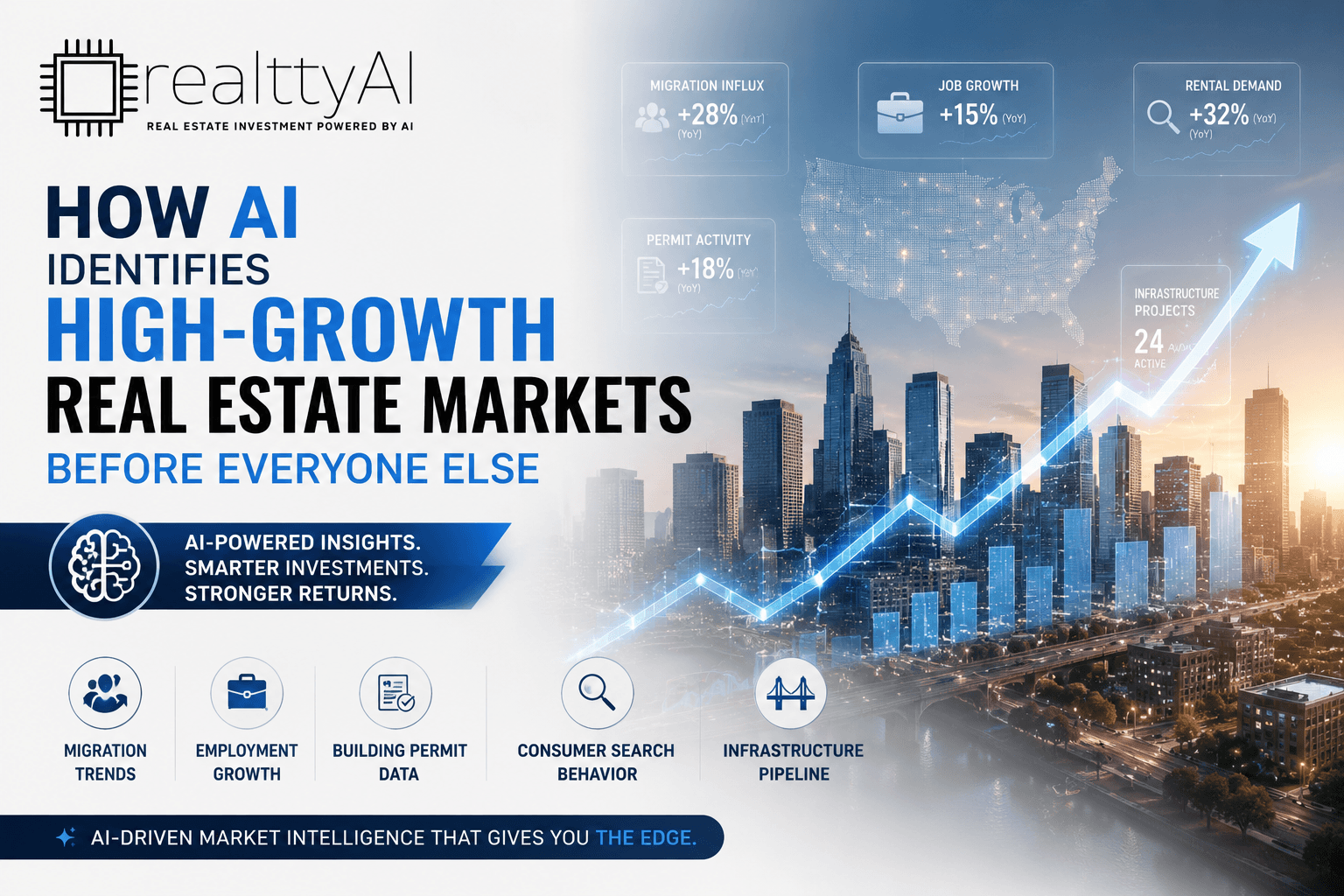
AI-powered Real Estate Investment Platforms work differently. They continuously process real-time and forward-looking signals across five key data categories: Migration Patterns , Employment Shifts , Building Permit Filings , Consumer Search Behavior , and Infrastructure Pipeline s.
Migration and Employment Trends
AI systems analyze net in-migration data , including IRS tax filings, USPS change-of-address data, and U-Haul destination trends. When people move into a market faster than housing supply grows, property appreciation often follows within 3–6 months .
Furthermore, AI tracks new employer announcements, job posting density, and industry expansion trends. Markets with growing tech, healthcare, and logistics employment typically experience rising rental demand within 60 days .
Supply and Search Behavior
Monitoring city and county permit filings helps AI platforms determine whether future housing supply can absorb incoming demand. A market with increasing demand and a slow construction pipeline becomes a strong target.
Search trends for phrases like “apartments for rent in [city]” act as leading indicators . AI tools detect these patterns 4–8 weeks before pricing shifts appear in public MLS data.
3 Markets AI Flagged Early — With Validated Results
Charlotte, NC : AI identified accelerating financial-sector job growth and rising migration. Investors captured appreciation rates between 14–18% in select zip codes.
Indianapolis, IN : Expanding logistics employment and affordability advantages created a strong AI buy signal before home prices rose.
Tampa, FL : AI systems specifically highlighted strong healthcare and technology sector growth in targeted corridors, outperforming the broader market.
How realttyAI Puts Institutional-Level Intelligence in Your Hands?
realttyAI processes all five signal categories in real time across every major U.S. metro area. Instead of spending 10–20 hours manually researching, investors can generate a comprehensive report in under two minutes .
The platform provides Market Opportunity Scores (0–100), 12-month demand projections , and AI-generated investment insights designed specifically for retail investors and small investment teams.
Why AI Is Becoming Essential?
The investors who consistently outperform don’t necessarily have better instincts — they simply have better information faster .
AI-Powered Real Estate Intelligence is reshaping how investors discover opportunities. In today’s environment, relying solely on outdated market reports and manual research creates a significant disadvantage .

realttyAI Real Estate Investment Team
Real Estate Investment Team
Expert insights on global real estate trends and AI-Powered Property Investment strategies.