 Back to Blogs List
7 Signs You’re Investing in the Wrong Real Estate Market (And What AI Would Have Told You)
Introduction
Some of the biggest real estate investment losses over the past decade were not caused by bad luck — they were caused by ignoring critical market signals that were already visible in the data.
During the 2022–2024 market corrections in cities like Austin and Boise , warning signs appeared months before property values declined. Inventory surged , rent growth slowed, and migration trends reversed.
Today, AI-Powered Real Estate Analysis Platforms like realttyAI automatically monitor these signals in real time — helping investors identify risky markets before losses occur.
Warning Signs 1 & 2: Supply and Pricing Vulnerability
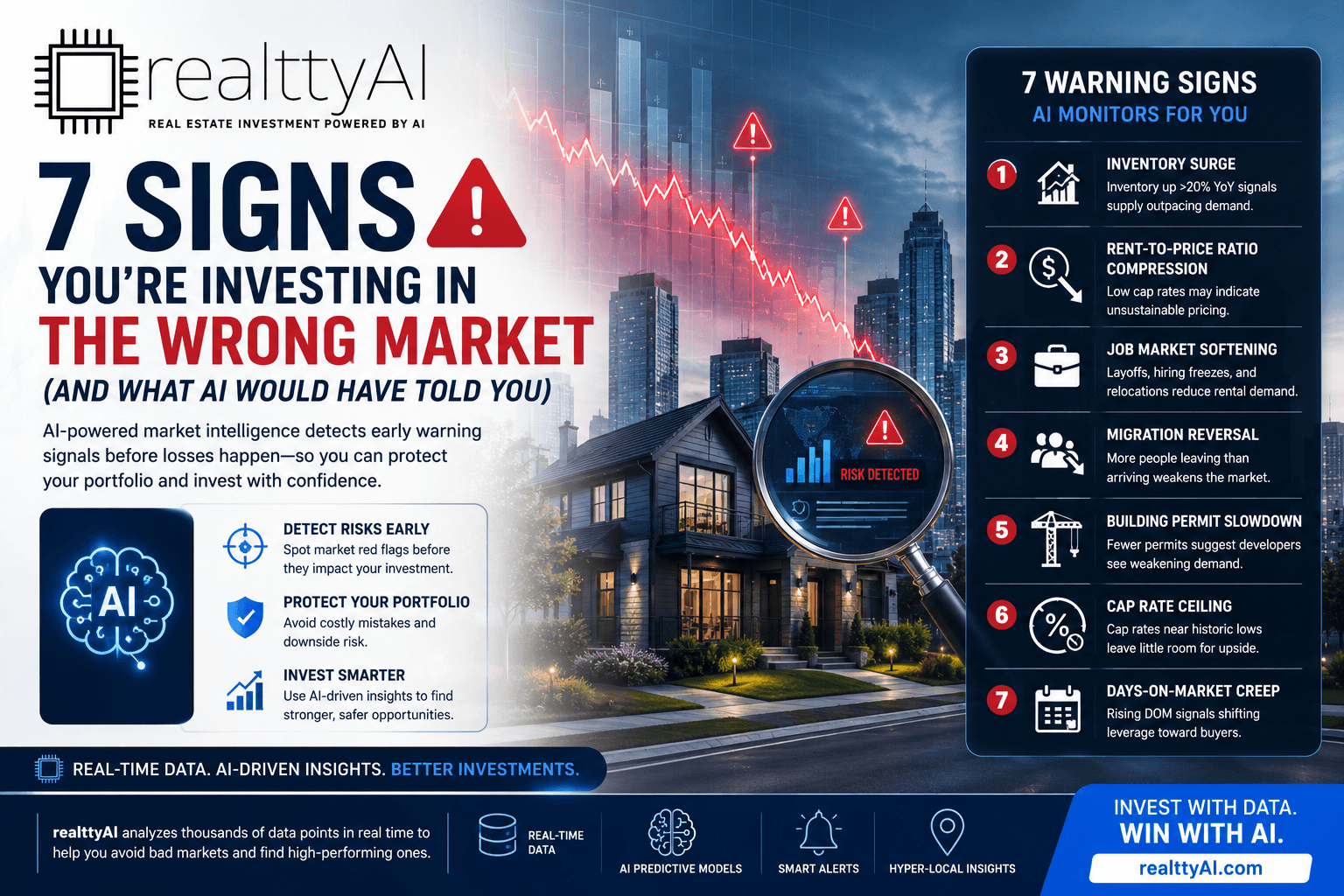
Sign 1: Inventory Surge . One of the earliest indicators of a weakening market is a sharp rise in active property inventory. When housing inventory increases more than 20% year-over-year , it often means supply is outpacing demand.
Sign 2: Rent-to-Price Ratio Compression . A market becomes risky when property prices rise faster than rental income. When cap rates fall below sustainable levels (often under 4.5%), investors are relying too heavily on future appreciation assumptions rather than stable cash flow.
Warning Signs 3 & 4: Economic and Demographic Shifts
Sign 3: Job Market Softening . Employment growth is a primary driver of rental demand. When major employers announce layoffs or hiring freezes, the local housing market often weakens within 60–90 days .
Sign 4: Migration Reversal . One of the most reliable leading indicators is net out-migration. AI platforms analyze USPS change-of-address and U-Haul data to predict price declines 4–8 months before they appear in public reports.
Warning Signs 5, 6 & 7: Development and Momentum
Sign 5: Building Permit Slowdown . A decline in permits indicates that developers believe demand is weakening. Sign 6: Cap Rate Ceiling . Every market has a floor; when pricing becomes too aggressive relative to income, downside risk increases.
Sign 7: Rising Days on Market (DOM) . When median days on market begins increasing after a long period of tight inventory, it signals a major shift in momentum , leading to more price cuts and reduced buyer urgency.
How realttyAI Automates Real Estate Risk Screening
Instead of manually tracking dozens of risk indicators, realttyAI automates the process by analyzing inventory, rental demand, and migration patterns in real time.
Investors receive a dynamic Market Risk Score (0–100) that updates as new data enters the system. This allows for zip-code-level investment analysis and early warning detection for market corrections.
Conclusion
Bad real estate markets rarely collapse overnight. They weaken gradually through rising inventory and slowing rent growth long before headlines catch up.
In modern real estate investing, having faster and better data is no longer optional — it’s a competitive advantage that protects your portfolio.

realttyAI Real Estate Investment Team
Real Estate Investment Team
The Investor’s Guide to Predictive Property Analytics: Cap Rates, ROI & AI